|
|
|
|
|
|
|
|
|
|
|
|
|
|
|
|
|
|
|
|
|
|
|
 |
|
|
|
|
|
|
|
GRANITE AUDIO is a system concept.
A system with true synergy.
|
|
|
|
|
|
|
|
|
|
 |
|
|
|
|
|
|
|
|
|
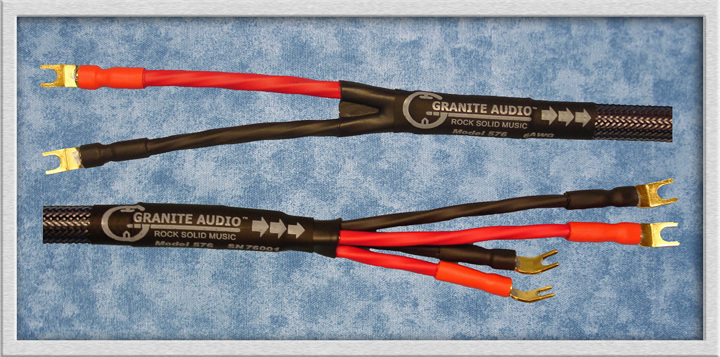
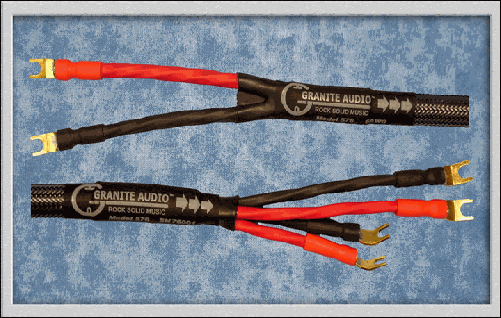
Model 570, 573, 575, 576, 577, 578
Speaker Cables
|
|
|
|
|
|
|
|
|
|
|
|
|
 |
|
|
|
|
|
|
|
|
|
|
|
|
|
|
|
|
|
All new 2012 models.
99.9999% Pure OFC Copper from 10AWG to 5AWG.
These high powered cables are engineered for a smooth musical performance. They are made with ultra-fine hair-like strands of the purest best sounding copper available and grouped into bundles. This makes these quality cables extremely flexible and minimizes unwanted interactions in the conductors. Using ultra-fine wires maximizes the surface area of the copper conductors and fully takes advantage of the great sonic benefits of skin effect in high powered speaker cable construction. Grouping these hair-like wires into bundles also means all the models can be bi-wired and some can even be tri-wired.
The ultra-pure continuous-cast oxygen-free copper wires give the music warmth and good detail, because it's a virtually perfect Single-Crystal Copper conductor. All our cables are sequentially cut from the master spool and serial numbered to keep them in order. Sequential serial numbered cables are not only continuous crystal, . . . . they are the same continuous crystal.
And the larger gauge cables give full power and robust bass response in high powered solid-state systems and even more so in today's best tube amp systems. The larger the cable's gauge, the lower its impedance. The lower the impedance, the more power it transmits to the speakers. We recommend you maximize your power amps' performance and power output by getting larger gauge speaker cables. Maximize the power and minimize the current limiting in your speaker cables.
Which model speaker cable should I buy?
With Granite Audio speaker cables, the larger the gauge, the better it will sound. There are several good reasons for this. The larger gauge has a lower impedance which allows the cable to deliver more power, faster, to your speakers. This is important in today's high quality amps and recordings that have more live dynamic music passages that demand fast maximum power for full lifelike music reproduction. If you've ever thought your music sounded restricted, power limited, or otherwise dynamics challenged; then you should consider trying higher-gauge/lower-impedance speaker cables & power cords that are less current-limiting on your demanding system and will deliver the fast full dynamics of your favorite music. Don't waste your amp's watts trying to drive speaker cables that are too small or high impedance.
The larger gauge cables also have more hair-like strands of pure copper wire. This increases the surface area, which increases the skin effect, which then benefits the high frequencies and overall tonal balance of the music. Many other brands of speaker cables use fewer strands because it's cheaper and easier to build. But, I can also put these Brand X cables on the test bench and measure the high frequency roll off. I've seen a 6dB drop above 15KHz , making the music sound very dark and dull, with very little life left in it.
The larger gauge cables also have more bundles of copper wires. This increases the separation of the conductors and minimizes the interaction between the conductors. It also improves the capacitance and inductance measurements in the cable for better sonics.
Our recommendation? Buy the bigger cable and get the best music performance that your system can deliver. If you like our Granite Audio Sound, you'll love our larger gauge cables even more. Bigger does sound better when you're talking about speaker cables.
|
|
|
|
|
|
|
|
|
|
|
|
|
|
|
|
|
|
|
|
|
|
|
|
|
"Dear Don, Got the Model 570 Speaker Cables yesterday and hooked them this morning. Wow. Much nicer than described. Highs are better defined, mids unchanged, and bass licks rock solid (esp tom-tom, bass drum, and bass guitar). Very MUSICAL indeed. No ear fatigue. Bonnie Raitt, Sting, and Carlos Santana never sounded better. Thanks,"
Bob B. Paducah, KY.
More about Continuous Cast Copper.
The most important factor in cable design is the quality of the conductor. The introduction of Continuous Cast Copper allows the creation of virtually perfect conductors. The process forms conductors of nearly perfect structure, with flawless, mirror-like surfaces, and high flexibility and great fatigue and corrosion resistance.
The grain (crystal) structure of metals has always been a limiting factor in cable design. Gases and solid impurities collect at the grain boundaries, forming non-linear (diode) junctions. These non-linearities cause the harsh, grainy sound quality of many cables.
A one-meter strand of drawn copper wire, 0.3mm in diameter, consists of from 50 to 40,000 individual crystals (depending on the quality of the copper). Since no conductor is absolutely pure, each crystal boundary becomes a diode, adding its own non-linearity (however weak) to the signal.
The Continuous Casting process eliminates this source of distortion by eliminating the grain boundaries. In Continuous Cast cables, each crystal is 125 meters long. This means that, even in long cables, there's never more than one crystal junction per strand.
The single-crystal structure permits unimpeded signal propagation. The result is an extremely neutral sound with grain-free, extended highs that are open, airy, and detailed. This improvement is apparent throughout the full frequency range, even down to the bottom end, whose weight, space, and air are fully reproduced.
|
|
|
|
|
|
|
|
|
|
|
|
|
|
|
 |
|
|
|
|
|
|
|
|
|
|
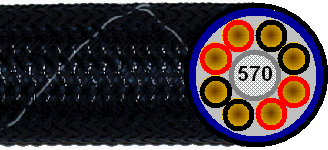
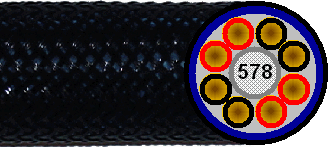
There are 520 Individual strands of copper wire in this cable, divided into 8 insulated bundles that can be bi-wire terminated. Black braid w/white tracer outer cover.
The Model 570 was our first speaker cable and has become world renowned for its great sonic performance since its introduction in 1998 at Stereophile's HiFi98 Show in Los Angeles. Jonathan Scull and Larry Greenhill both raved about our system performance at that show.
|
|
|
|
|
|
|
|
|
|
 |
|
|
|
|
|
|
|
|
|
|
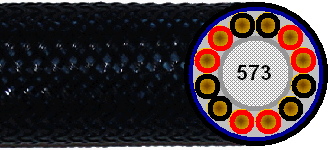
There are 840 Individual strands of copper wire in this cable, divided into 8 insulated bundles that can be bi-wire terminated. Black braid outer cover.
This model is almost identical to our popular Model 573 cable, except that it cannot be tri-wire terminated and has 7% more copper with the additional 60 strands of pure copper.
|
|
|
|
|
|
|
|
|
|
 |
|
|
|
|
|
|
|
|
|
|
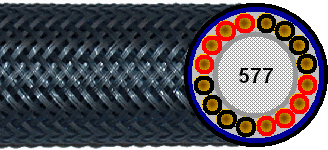
There are 780 Individual strands of copper wire in this cable, divided into 12 insulated bundles that can be bi-wire or tri-wire terminated. Black braid outer cover.
This was our second model speaker cable and has been our standard CES Show Reference System cable since its introduction. It also became very popular with our previous 570 owners who later upgraded to the 573 after hearing it at CES. Our customers' & dealers' overwhelming positive feedback on the great sonic improvements of the larger gauge was a major motivation in our 2012 introduction of even larger gauge cables of 7, 6, and 5AWG models featured below.
|
|
|
|
|
|
|
|
|
|
 |
|
|
|
|
|
|
|
|
|
|
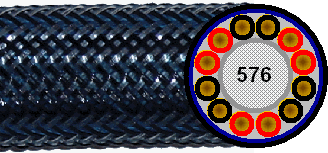
There are 1040 Individual strands of copper wire in this cable, divided into 16 insulated bundles that can be bi-wire or tri-wire terminated. Gray braid outer cover.
|
|
|
|
|
|
|
|
|
|
 |
|
|
|
|
|
|
|
|
|
|
There are 1260 Individual strands of copper wire in this cable, divided into 12 insulated bundles that can be bi-wire or tri-wire terminated. Graphite braid outer cover.
|
|
|
|
|
|
|
|
|
|
 |
|
|
|
|
|
|
|
|
|
|
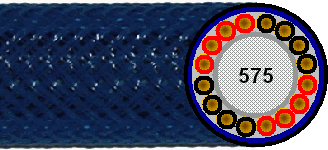
There are 1680 Individual strands of copper wire in this cable, divided into 16 insulated bundles that can be bi-wire or tri-wire terminated. Blue braid outer cover.
|
|
|
|
|
|
|
|
|
|
|
|
|
|
|
|
|
|
|